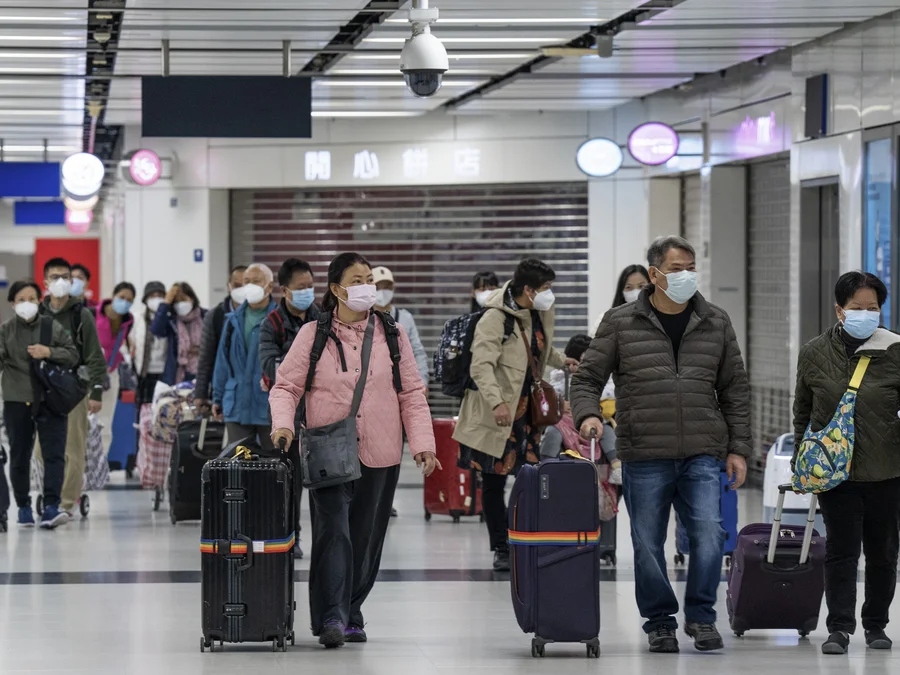
After years of being separated from his wife
in mainland China, Hong Kong resident Cheung Seng-bun made sure he was among the first in line after border crossings reopened on Sunday. The ability of residents of the semi-autonomous southern Chinese city to cross the border is one of the most visible signs of the easing of border restrictions imposed by China nearly three years ago, as travelers arriving from abroad no longer have to go through costly quarantines.
Even as the virus continues to spread in China, critics say there is a lack of transparency from Beijing. Intersection at Lok Ma Chau station, which was constantly
crowded with eager travellers.
However, people crossing between Hong Kong and mainland China are still required to show a negative COVID-19 test taken within the past 48 hours, a measure China has protested when asked by other countries was imposed. Hong Kong has been hit hard by the virus as its land and sea border checkpoints with the mainland have been largely closed for nearly three years. It is expected to provide a much-needed boost to Hong Kong's tourism and retail sectors.
In a visit to the station on Sunday morning, Hong Kong Chief Executive John Lee said the parties would increase the number of border crossings to a full 14 from the current seven. "The goal is to come back as soon as possible." to normal life before the epidemic," Lee told reporters. "We want the cooperation between the two sides to get back on track." 200 passengers,
, were to take the ferry to Hong Kong, while another 700 would travel by ferry the other direction on the first day of reopening. Tan said a steady increase in ridership is expected in the coming days.
"I stayed up all night and got up at 4 a.m.," she said upon arrival in Shenzhen, where she was presented with "roses and health kits," according to the newspaper. About 300,000 people are expected to travel, according to Hong Kong media reports. Reservations have already been made from the city to mainland China, with a daily quota of 60,000. Limited ferry service from China's Fujian Province to Taiwan-controlled Kinmen Island has also been restored in light of the Chinese coast.
The border crossing with Russia at Suifenhe withinside the a ways northern province of Heilongjiang additionally resumed everyday operations, simply in time for the outlet of the ice competition withinside the capital of Harbin, a first-rate tourism draw.
And at Ruili, at the border with Myanmar, everyday operations have been resumed after 1,012 days of complete or partial closure in reaction to repeated outbreaks blamed in part on traffic from China's neighbor.
So a ways, simplest a fragment of the preceding variety of global flights are arriving at essential Chinese airports.
Beijing's primary Capital International Airport become awaiting 8 flights from remote places on Sunday. Shanghai, China's biggest city, acquired its first global flight below the brand new coverage at 6:30 a.m. with simplest a trickle of others to follow.
Since March 2020, all global passenger flights sure for Beijing had been diverted to precise first factors of access into China. Passengers have been required to quarantine up to a few weeks.
"I've been below remoted quarantine for 6 instances in distinctive towns (in mainland China)," stated Ivan Tang, a Hong Kong commercial enterprise traveler. "They have been now no longer clean experiences."
Ming Guanghe, a Chinese residing in Singapore, stated it have been tough each to ee-e book a price price tag and discover someplace to take a PCR test. Quarantine measures and uncertainty approximately outbreaks had stored him farfar from home, Ming stated.
Shanghai introduced it might once more begin issuing normal passports to Chinese for overseas journey and own circle of relatives visits, in addition to renewing and increasing visas for foreigners. Those regulations have had a specially devastating impact on overseas businesspeople and college students withinside the key Asian monetary center.
China is now going through a surge in instances and hospitalizations in essential towns and is bracing for a in addition unfold into much less evolved regions with the begin of its maximum vital holiday, the Lunar New Year, in coming days.
Officials expect domestic air and rail travel to double from the same period last year, bringing the totals closer to those of the pre-pandemic 2019 holiday season. Meanwhile, more and more foreign governments are imposing testing requirements for travelers from China. — more recently, Germany, Sweden and Portugal. On Saturday, German Foreign Minister Annalena Baerbock urged citizens to avoid "unnecessary" travel to China, citing rising coronavirus cases and China's "overwhelmed" health system with
check-ups on arrival. Like other European nations, Germany will test aircraft waste water for possible new variants of the virus.
The measures will come into effect at midnight on Monday and will apply until April 7th. Clearly concerned about its reputation, China says the testing requirements have no scientific basis and has threatened unspecified countermeasures. Chinese health authorities release a daily tally of new infections, severe cases and deaths, but these numbers only include officially confirmed cases and use a very narrow definition of COVID-19-related deaths. The National Health Commission on Sunday reported
new confirmed cases of local transmission and 7,072 new cases and two new deaths - although individual provinces reported up to 1 million cases a day. Officials say that since the government has scrapped mandatory testing and allowed people with mild symptoms to get tested and recover at home, it is no longer able to provide a full picture of the outbreak.
China's vulnerability is compounded by a general lack of population exposure to the virus and a relatively low vaccination coverage among the elderly. Government spokesmen insist the situation is under control, dismissing accusations from the World Health Organization and others that it is not. Transparency about the outbreak that could lead to the emergence of new variants. The Health Commission on Saturday implemented regulations to strengthen surveillance for virus mutations,
, including testing of urban sewage. The rules called for more data collection from hospitals and local health authorities. departments and increased checks for "pneumonia of unknown cause".
There was also anger over the requirement that anyone who tests positive or has been in contact with such a person be locked up for observation in a field hospital where overcrowding, poor nutrition and hygiene prevail. The social and economic costs eventually sparked rare street protests in Beijing and other cities, possibly influencing the Communist Party's decision to quickly ease tougher measures.